Home Builders
The R&D Tax Credit Explained
The Research & Development (R&D) Tax Credit is a federal program that provides a dollar-for-dollar reduction in tax liability for companies that invest in innovation and technical problem-solving. While commonly associated with manufacturing or tech, home builders can also qualify, especially when developing new construction methods, energy-efficient designs, or custom solutions for complex builds.
If your firm is experimenting with materials, building techniques, energy systems, or prefabrication methods, you may be eligible—even without a dedicated R&D department.
QUALIFYING ACTIVITIES
Home builders often engage in R&D through innovation, testing, and problem-solving. Common qualifying activities include:
- Designing energy-efficient homes that meet LEED, Net-Zero, Passive House, or similar standards.
- Experimenting with new construction materials, such as recycled composites, cross-laminated timber, or insulating concrete forms.
- Developing modular or prefabricated building systems to reduce waste or increase speed.
- Engineering solutions for difficult site conditions, such as unstable soil, water management, or slope grading.
- Integrating smart home systems or custom HVAC, electrical, or plumbing configurations.
- Improving framing, roofing, or insulation methods for better durability or efficiency.
- Developing custom foundations or load-bearing solutions for non-standard home designs.
The key is eliminating technical uncertainty through a systematic process of experimentation.
WHAT cAN BE CLAIMED
Qualifying expenses for home builders include:
- Employee wages for engineers, architects, designers, supervisors, and support staff involved in technical development.
- Materials and supplies used in prototype homes, pilot projects, or test assemblies (e.g., new framing techniques, insulation tests).
- Contract research expenses, such as consultants, energy auditors, or structural engineers helping with new techniques.
- Depreciation or rental of equipment used exclusively for R&D (e.g., tools used for test builds or material testing).
Note: Expenses must be directly tied to research activities performed in the U.S.
WHAT DOESN'T QUALIFY
Routine or cosmetic work doesn’t count. The following are not eligible:
- Standard construction methods without a technical challenge.
- Aesthetic changes, such as flooring design or exterior paint schemes.
- Permitting, zoning, or legal compliance work.
- Marketing, sales, or real estate activities.
- Work funded by government grants or third parties.
- Research conducted after a technique has been proven and commercialized.
HOW THE CREDIt WORKS
The R&D tax credit reduces your federal tax liability and can be applied in two primary ways:
- Offsetting income taxes – For profitable builders.
- Offsetting payroll taxes – If you’re a qualified small business (under 5 years old, under $5 million in gross receipts), you can use the credit to offset up to $500,000 in payroll tax annually.
Unused credits can be carried forward for up to 20 years.
Average R&D Tax Credit for Home Builders
Based on similar industries, estimates are:
- Small to mid-sized builders: $10,000–$60,000 per year in credits.
Innovative or larger builders working on energy-efficient homes, modular systems, or custom design challenges: $75,000–$200,000+ annually.
For Small to Mid-Sized Home Builders
You likely qualify if you:
- Have developed energy-efficient home models.
- Solve structural or utility layout issues on challenging lots.
- Build unique or custom homes with nonstandard configurations.
- Are exploring alternative building materials or systems.
If you meet the startup criteria (under 5 years, under $5M revenue), the payroll tax offset can be especially valuable in early stages.
For Larger Builders or Multi-State Developers
Bigger builders with design and engineering teams may qualify for significantly more:
- Formal processes for testing construction materials or designs.
- R&D on prefabricated home components or system-built structures.
- Structured efforts to meet or exceed national energy efficiency standards.
These firms often benefit from multi-year R&D studies and can claim six-figure credits annually.
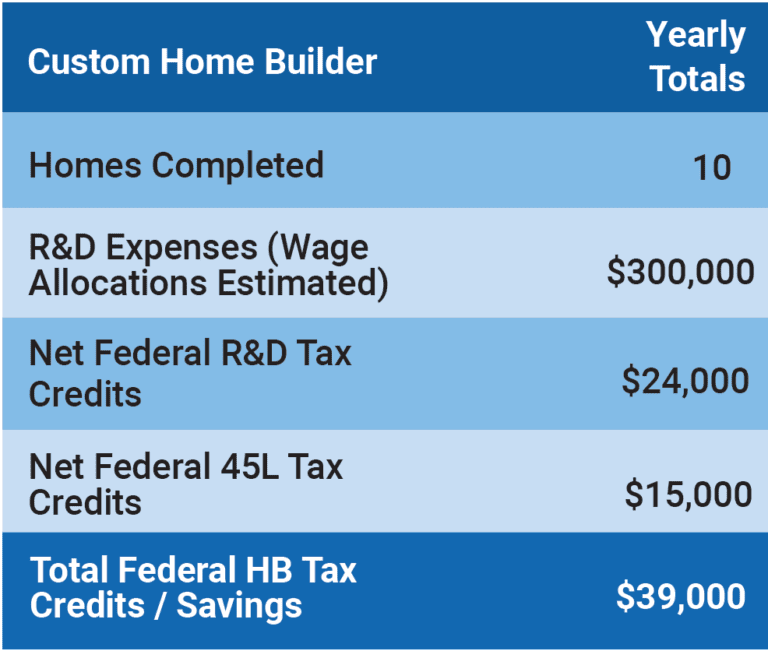
Home Builder CASE STUDY